
Guidance for Completing the “Annual Accessibility Audit for United Methodist Churches” updated 2024 version
Instructions
Per the Book of Discipline (¶2533.6) the local church Trustees committee is responsible for conducting an annual audit. Assemble a team of persons including persons with disabilities and family members, members with experience in rehabilitation and construction, and church staff members in addition to someone from the Trustees. Note that the audit form is now available in a fillable PDF version for ease of use!
Based on your findings, mark “Yes” if the item is true. Focus on your main accessible entrance and on Sunday morning activities, especially worship. Not every restroom, fountain, etc., needs to comply. If the intent of the item is adequately met in a different way, e.g., greeters are posted throughout the morning on Sundays to open doors and provide directions, mark it “Yes.”
If only part of a multi-question item is met, mark that item “No” unless alternatives are given, as designated by “or.” If an item occurs at least 85% of the time (e.g., microphone use in worship and large meetings), score it “Yes.” If a system is in place to provide services (e.g. “buddy” companions), mark “Yes” even if no one is using the service. Mark “No” if an item is not currently met, and explain the problem and any changes needed in the comments column.
Scoring is encouraged, but optional. See page 4 of the Audit for scoring instructions.
Badge Level Key:
B = Bronze
S = Silver
G = Gold
(See pp. 15–16 for more details)
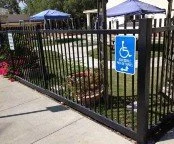
Section 1.1
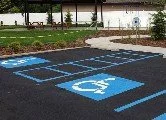
Section 1.3
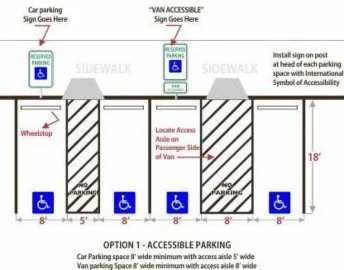
Section 1.4
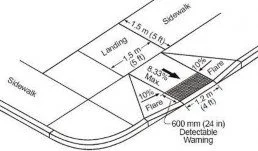
Section 1.8
Section 1.10
Section 1.11
Section 1.12
Section 1.14
Section 2.15
Section 2.17
Section 2.23
Section 2.24
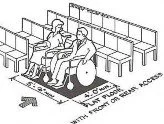
Section 3.30
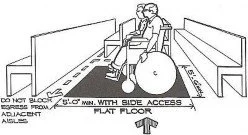
Section 3.31
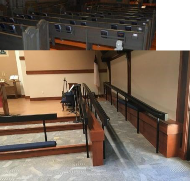
Section 3.32
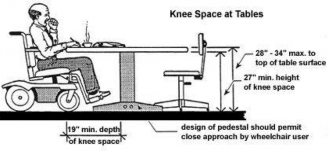
Section 3.36
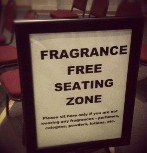
Section 4.38
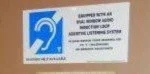
Section 4.44A
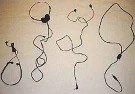
Section 4.44B
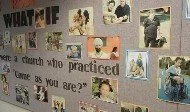
Section 4.50
Section 4.57
Section 1: GETTING INTO THE CHURCH
Clearly visible signs mark or direct people to accessible entrances. (B)
Intent: Visitors can locate an accessible entrance without having to get out of their car or walk around the building to find the entrance.
Guidance: Signs on each side of the building should direct persons to the accessible entrance(s). If a marked accessible entrance door is close to the accessible parking, and is clearly level and accessible, mark this “Yes.”1+ ADA parking spaces are on level ground near entrance. (B)
Intent: ADA parking space(s), adjacent access aisle(s), and the pavement that leads to the access path are relatively level so that walkers and wheelchairs don’t roll away or veer sidewise when a person is getting in and out of the car, transferring into a wheelchair, and getting to the access path. The distance from ADA parking to the accessible door is as short as possible for people with limited mobility or endurance.Guidance: Any slope with more than 1” rise in 20 feet is considered a ramp and is not level. ADA spaces
should be in the part of the parking lot closest to the nearest accessible entrance to the building.
Wheelchair users don’t have to move behind parked cars, cross traffic. (G)
Intent: People who use mobility devices can get to the access pathdirectly, avoiding possible injury from drivers backing up and not seeing a person in a wheelchair moving behind their car.
Guidance: See diagram and photo for layout options.
At least 1 per 25 spaces is clearly marked with access symbol on vertical signs and on pavement. (S)
Intent: There are sufficient accessible parking spaces for the size of the congregation.Guidance: Divide total spaces by accessible spaces to calculate. The accessible logo is painted on the pavement at each space. The sign can be seen above car height; this is useful when snow is on the ground. “Senior” parking spaces without access aisles are helpful for some congregants but don’t count for this item, even if they are inappropriately marked with ADA signs. See “Accessibility Tip: Accessible Parking Guidelines” for details.
Accessible spaces are 8’ wide with adjacent 5’ access aisle. (B)
At least one accessible space is van accessible. (S)
36” wide curb cuts (curb ramps) are provided close to parking. (B)
Route from accessible parking to accessible entrance is smooth, flat, & at least 36” wide. (B)
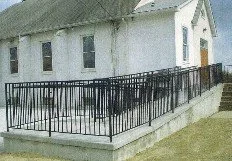
Entrance is level or has exterior ramp with non-slip surface, minimum 36” width. (B)
Ramp has max incline of 1:12 with no more than 30’ between level landings. (S)
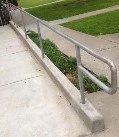
34–38” handrails are on both sides of ramp/stairs. (S)
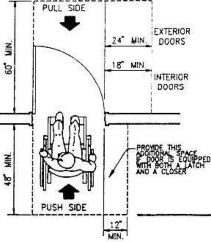
60” x 60” level platform at entry door, or automatic door opener is used. (B)
Automatic door opener or attended doorbell for assist. (G)
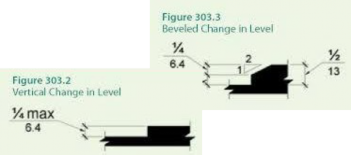
Entrance door is 36” wide; threshold ≤ ½” high beveled. (B)
Section 2: GETTING AROUND THE CHURCH
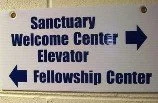
Signs in entrances/halls direct visitors. (B)
Corridors are at least 36” wide with non-glare floor surface. (B)
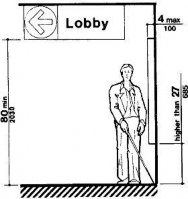
Objects protruding more than 4” are detectable with cane. (B)
Multi-level buildings provide access to all common/program areas via elevator, lift, ramp—or building is one level. (B)
Interior doorways have 32” clearance; thresholds ≤ ½” beveled. (B)
ADA bathroom/common area doors have easy handles, ≤ 6 lbs force. (S)
Carpet pile ≤ ½” thick, firm padding; mats non-slip. (S)
Fire alarms and extinguishers ≤ 48” from floor; visual & auditory alarms present. (G)
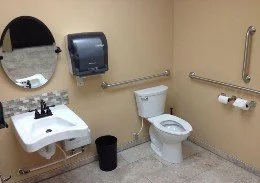
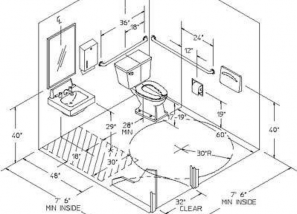
At least one marked ADA restroom (or stall) per floor with 60”x60” turning space, grab bars, proper toilet height. (B)
Sink clearance 27” with easy controls, pipes covered. (S)
Soap/towel dispensers ≤ 48” or on counter. (B)
Mirror bottom edge ≤ 40”. (B)
Drinking fountain ≤ 36” with hand controls, or paper cups provided. (B)
Interior stairs/ramps have handrails both sides, or all one level. (B)
Step/ramp edges marked, or all one level. (S)
Section 3: SANCTUARY, CLASSROOMS, FELLOWSHIP
Level pew cuts/spaces for wheelchairs. (B)
Wheelchair spaces distributed throughout room with view of pulpit/screen. (S)
Chancel & choir loft accessible. (G)
Handrail(s) on steps to chancel. (S)
At least one aisle ≥ 36”. (B)
Fellowship is offered in accessible space. (B)
At least one table has 27” clearance, ≤ 34” height. (B)
1–2 sturdy chairs with arms, ~18” seat, no wheels. (B)
Section 4: COMMUNICATIONS & ENVIRONMENT
Congregation sensitized to minimize fragrances. (S)
Soaps/cleaners/candles are fragrance-free. (G)
Projected words use large font and good contrast. (S)
Large-print bulletins available. (B)
Braille/electronic documents provided upon request. (S)
Microphone used by all speakers. (B)
Assisted listening system available. (S)
ASL interpreter provided upon request. (G)
Sermon available in print/email upon request. (S)
Captions provided/turned on for videos/media. (G)
Section 5: ATTITUDES
Accessibility info and contact listed in bulletin/website/signage. (B)
Leaders/ushers trained in disability etiquette. (B)
Visible evidence that people with disabilities are included. (S)
Disruptions accepted and incorporated into worship. (B)
Service animals welcome. (B)
Inclusive, person-first language used in worship. (B)
Classes/programs adapted for participation. (S)
Disability Awareness Sunday observed in last 1–2 years. (B)
Gifts of persons with disabilities used in service/worship/leadership. (S)
Dietary needs considered, incl. gluten-free & alcohol-free communion. (B)
Transportation/valet/parking assistance offered. (S)
“Buddy” system available for those needing 1:1 support. (S)
Additional Information
Goals: Set priorities and add to Trustees’ 5-year plan.
Consultation: Contact your Conference Disability Ministries Committee for support.
Comments: Explain “No” answers in detail.
Signatures: Pastor and Trustees chair should sign.
Dates: Complete before Charge Conference.
Process & Disclaimer
For existing buildings only. Refer to ADA and state regulations for new construction.
Include persons with disabilities in the audit team.
Use congregational surveys to gather feedback.
Items in this audit are minimum expectations, not a full ADA audit.
Scoring
≥ 85% at a level earns that badge (Bronze, Silver, Gold).
≥ 51% overall = Copper/Honorable Mention.
Levels:
Bronze – Basic accessibility (self-reported).
Silver – Many accessible features (self-reported).
Gold – Full accessibility, requires application & review.
Next Steps
Submit completed audit with Charge Conference packet.
Apply for badge through your conference or the Disability Ministries Committee.
Use badge in website, bulletin, newsletter.
Celebrate achievement with the congregation.
Updated May 7, 2025 by Deaconess Lynn Swedberg